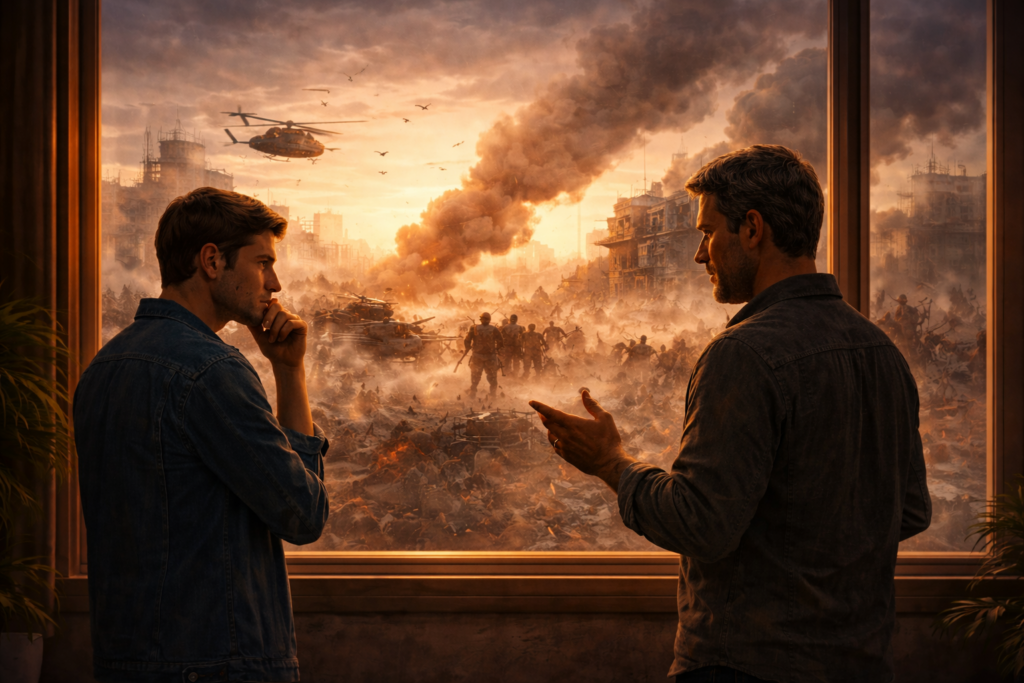
Last week, I was speaking to a friend who tried to explain that the wars we see around the world today are simply a reflection of a natural human tendency. His argument was straightforward: humans, despite all our claims of civilization and progress, remain part of the animal kingdom. In nature, competition for dominance, territory, and resources is normal. Animals fight for space and survival, and humans, being more evolved but still biological beings, are not entirely different. From that perspective, wars are merely a scaled-up version of the same competitive instinct. According to him, the relatively peaceful decades many of us grew accustomed to may have created a misleading impression that the world had somehow moved beyond war.
I felt, the argument appeared overly simple. I started doing a bit of research and found that it is an idea that has been seriously explored in academic research. Human beings did evolve in environments where competition mattered. Groups competed for food, territory, and security. Evolutionary scholars argue that traits such as coalition building, status seeking, and strong loyalty toward one’s own group were adaptive in such environments. At the same time, suspicion and hostility toward rival groups could also emerge as survival mechanisms. When these instincts operate at the scale of modern societies and nation states, they can manifest as large-scale conflicts. In that sense, war can be interpreted as an extension of intergroup competition that has existed throughout human history.
However, human evolution also produced another equally powerful capacity: cooperation. Unlike most species, humans developed complex social systems that enable large numbers of strangers to coordinate and collaborate. Institutions, norms, and systems of governance emerged precisely to manage conflict and channel competition into more constructive forms. The decades following the Second World War illustrate this possibility. Through the creation of international institutions, expanding economic interdependence, and diplomatic frameworks, the world experienced a prolonged period during which major powers avoided direct war with each other. This period is sometimes described as the “Long Peace.” Yet the relative stability of these decades may also have encouraged the belief that a stable world order had become permanent. The resurgence of conflicts in recent years suggests that such stability might be more fragile than we assumed.
Academic scholarship typically explains the causes of war through three major perspectives: evolutionary, realist, and liberal explanations.
The evolutionary perspective focuses on the biological and psychological roots of conflict. It suggests that humans possess inherited tendencies toward group loyalty and intergroup competition. These tendencies once served survival purposes in early human societies. When groups perceive threats to resources, status, or identity, these underlying instincts can contribute to organized conflict. From this perspective, war reflects deep-seated behavioral patterns that have accompanied human societies for millennia.
The realist perspective, which dominates much of international relations theory, shifts the focus from human nature to the structure of the international system. Realist scholars argue that the global system is fundamentally anarchic, there is no overarching authority capable of enforcing rules among sovereign states. Because states cannot fully rely on others for their security, they prioritize power and military capability. Even when leaders do not actively seek conflict, mistrust and competition can create conditions in which wars become more likely. In this view, war emerges less from instinct and more from the strategic dynamics of the system itself.
The liberal perspective offers a more optimistic interpretation. It emphasizes the role of institutions, economic interdependence, and democratic governance in reducing the likelihood of conflict. International organizations, trade relationships, and shared norms create incentives for cooperation and mechanisms for resolving disputes without violence. According to this perspective, peace is not accidental; it is constructed through rules, transparency, and mutual benefit.
Taken together, these perspectives suggest that war cannot be attributed to a single cause. Human evolutionary tendencies may create the potential for conflict, the structure of the international system may intensify competition, and the strength of institutions determines whether those tensions are managed or allowed to escalate. My friend’s argument, therefore, may capture one part of the story, but it is only one layer within a much more complex picture.
Perhaps the more accurate conclusion is that the absence of war is not the natural state of human civilization. Peace is something societies build, maintain, and constantly renegotiate. When the institutions and norms that sustain it weaken, the deeper currents of competition – whether biological, political, or strategic – can resurface.
