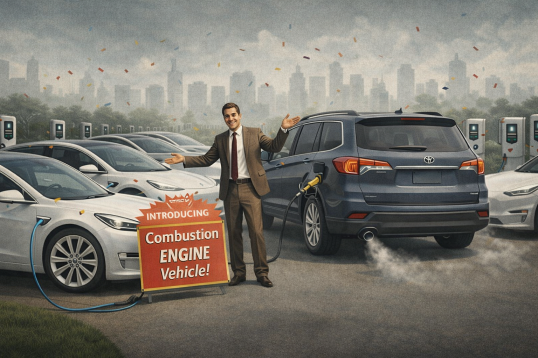
Imagine it is 2026.
For over a century, we have driven electric cars. We plug them in at home. They hum softly. They have few moving parts. They rarely break down. Cities are calmer. Mobility is seamless, predictable, almost boring in its reliability.
And then a startup announces a breakthrough.
“Ladies and gentlemen,” the founder declares, “we present the Internal Combustion Engine vehicle!”
It runs on liquid fuel. Hydrocarbons extracted from deep underground. You cannot generate that at home. You must drive to specialized retail outlets, called fuel stations, where you pump flammable liquid into a metal tank.
“Wait,” someone asks, “so instead of plugging in overnight while I sleep… I must go somewhere, queue, and manually refill?”
Yes.
Convenience, reimagined.
The technology, we are told, works by creating controlled explosions inside metal cylinders. Thousands of explosions per minute. The explosions push pistons, rotate shafts, turn gears and eventually moving the wheels.
Consumers, long accustomed to elegant electric drivetrains with minimal moving parts, now discover this new machine has hundreds. Pistons. Valves. Injectors. Timing belts. Oil pumps. Radiators. Exhaust systems.
“And if one small component fails?”
“Well,” the engineer says gently, “the vehicle may stop.”
Maintenance becomes a lifestyle. A recurring calendar event. A relationship with a mechanic. Regular oil changes. Filter replacements. Spark plugs. Coolant checks. Transmission servicing. Entire workshops dedicated to keeping the explosions under control.
Let us discuss efficiency.
Electric motors convert most of their stored energy into motion. This new engine? A large portion of the fuel’s energy is lost as heat. You also pay for a part of energy that quite literally evaporates into the atmosphere through what can only be described as a horizontal chimney at the rear.
Yes, there is smoke. Invisible sometimes, visible other times. Carbon dioxide. Nitrogen oxides. Particulate matter.
“Isn’t that… pollution?” someone asks.
“It’s a by-product,” the founder clarifies.
And cost? Ah, cost is fascinating.
First, you must build a global extraction industry. Then transport crude oil across oceans. Refine it in massive industrial complexes. Distribute it by tanker trucks. Store it in underground tanks across millions of locations.
Then, finally, you buy it at prices that fluctuate depending on wars, political decisions, and distant supply shocks.
“You mean my commuting cost depends on geopolitics?”
Yes. Adds excitement to Monday mornings.
Here comes the sensory experience.
These cars vibrate. They growl. It has a “dynamic presence.”
Citizens, who have known only smooth acceleration and silent streets, look slightly puzzled.
“So… we are introducing more mechanical complexity, more maintenance, lower energy efficiency, higher fuel volatility, controlled explosions, and a personal chimney… and calling it innovation?”
Yes. Disruption often arrives dressed as novelty.
The early adopters are enthusiastic. They love the ritual of refueling. They celebrate the mechanical choreography under the hood. Online communities debate torque curves and exhaust notes, a brand-new vocabulary built around combustion.
“For a century,” she says, “I woke up to a full charge. My car barely needed servicing. It converted energy efficiently. It didn’t leak fluids. It didn’t depend on global supply chains for daily operation.”
Now she is being asked to embrace a machine that is noisier, mechanically fragile, thermally wasteful, and atmospherically expressive.
From her perspective, it does not feel like innovation.
And here is the quiet historical twist:
Electric cars are not the newcomers in automotive history. Practical electric vehicles appeared in the early 1880s. In fact, electric cars were on the road before Karl Benz patented his gasoline-powered automobile in 1886.
Combustion did not replace electricity because it was inevitable. It replaced it because it scaled.
Normal is often just what scaled first.
So when we debate transitions today, when we call them unrealistic, disruptive, or inconvenient, perhaps we need to ask the question:
Are we just defending the accident of history that became familiar?
