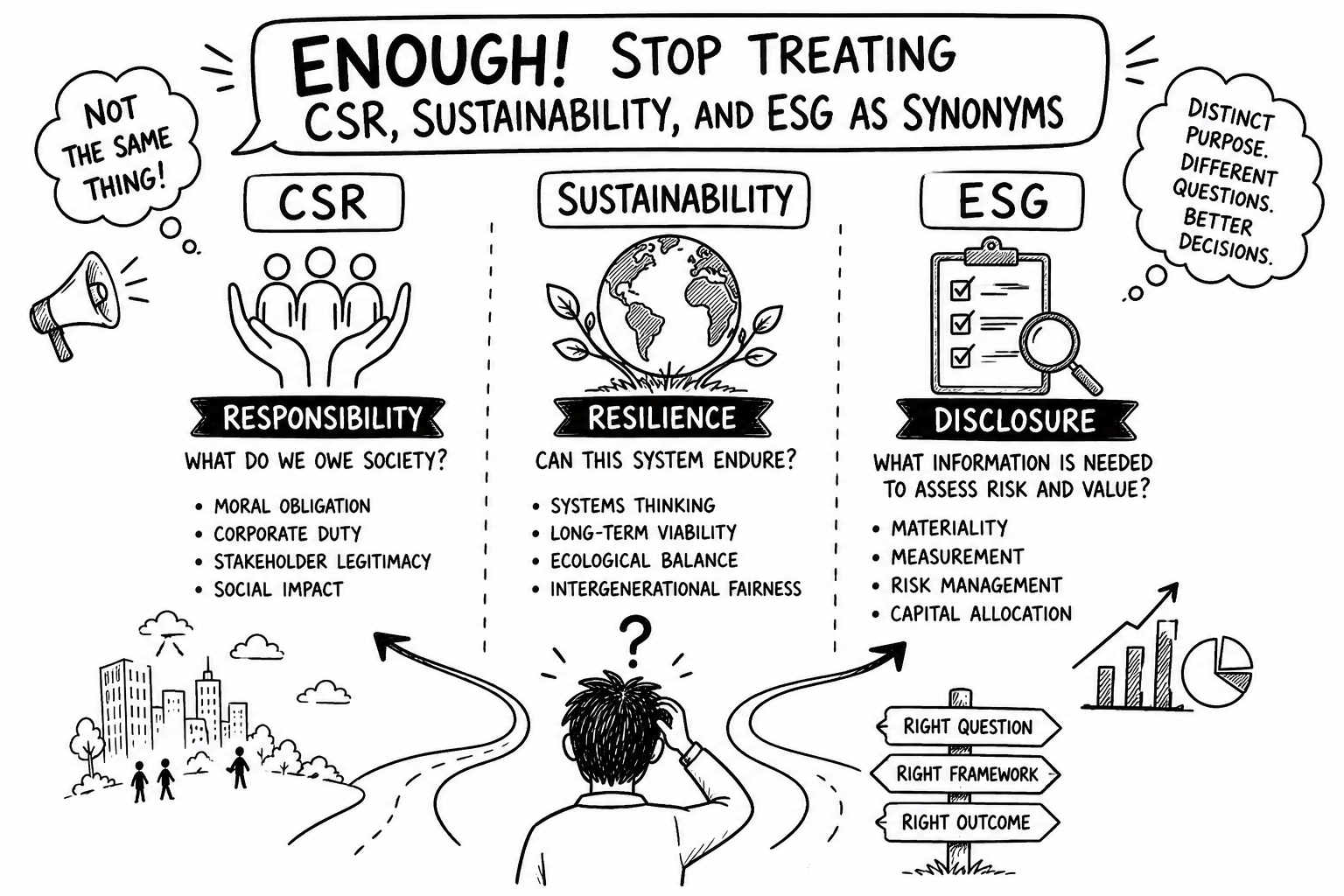
Enough. CSR, sustainability, and ESG are not interchangeable concepts, and treating them in that manner creates confusion in boardrooms, classrooms, and corporates alike.
They are not three labels for the same thing. Confusing them is like calling a sparrow, an ostrich, and an eagle the same bird, the differences matter too much to ignore. In corporate discourse, this conflation has become routine. For leaders who must decide, allocate, disclose, and act, the distinction is about strategic clarity.
Each framework has a different origin and that origin tells you everything.
Sustainability traces to A Blueprint for Survival (1972) and received its defining institutional form when the Brundtland Commission described sustainable development in 1987 as meeting present needs without compromising future generations. That definition established sustainability as a systems question, one that asks whether development itself is compatible with long-term ecological and social coexistence.
CSR belongs to a different tradition entirely. Howard Bowen’s Social Responsibilities of the Businessman (1953) placed business inside a moral and social order, not outside it. Carroll’s 1991 pyramid of economic, legal, ethical, and philanthropic responsibilities gave it managerial form. CSR is a normative account of what firms owe society.
In the Indian context, people understand CSR differently. Thanks to the regulatory definitions under the Section 135 of the Companies Act of 2013 and the following rules.
ESG emerged from the UN Global Compact’s Who Cares Wins initiative (2004) and the UN Principles for Responsible Investment (2006) for a specific purpose: giving investors, lenders, and analysts decision-useful data on non-financial risk and long-term value. ESG is an information framework. Its intended audience is the market.
Perhaps the simplest way to hold the distinction:
CSR asks, “What do we owe society?”
Sustainability asks, “Can this system endure?”
ESG asks, “What information is needed to assess risk and value?”
When leaders confuse these questions, strategy blurs and accountability weakens. When they distinguish them clearly, responsibility becomes purposeful, sustainability becomes actionable, and ESG becomes meaningful.

I am not surprised that such simple elucidation comes from you . Having breathed and practiced in this space , no one could better articulate it . It’s my opinion that Indian Corporations have understood CSR and Sustainability better than ESG. And here the specialists and the consultancy teams need to go beyond reporting . Very few work towards making ESG a part of their daily drill that is integrated to normal business. The whole ecosystem needs to go beyond ticking boxes and for that to happen these discussions need to receive as much importance as ROIs and market share