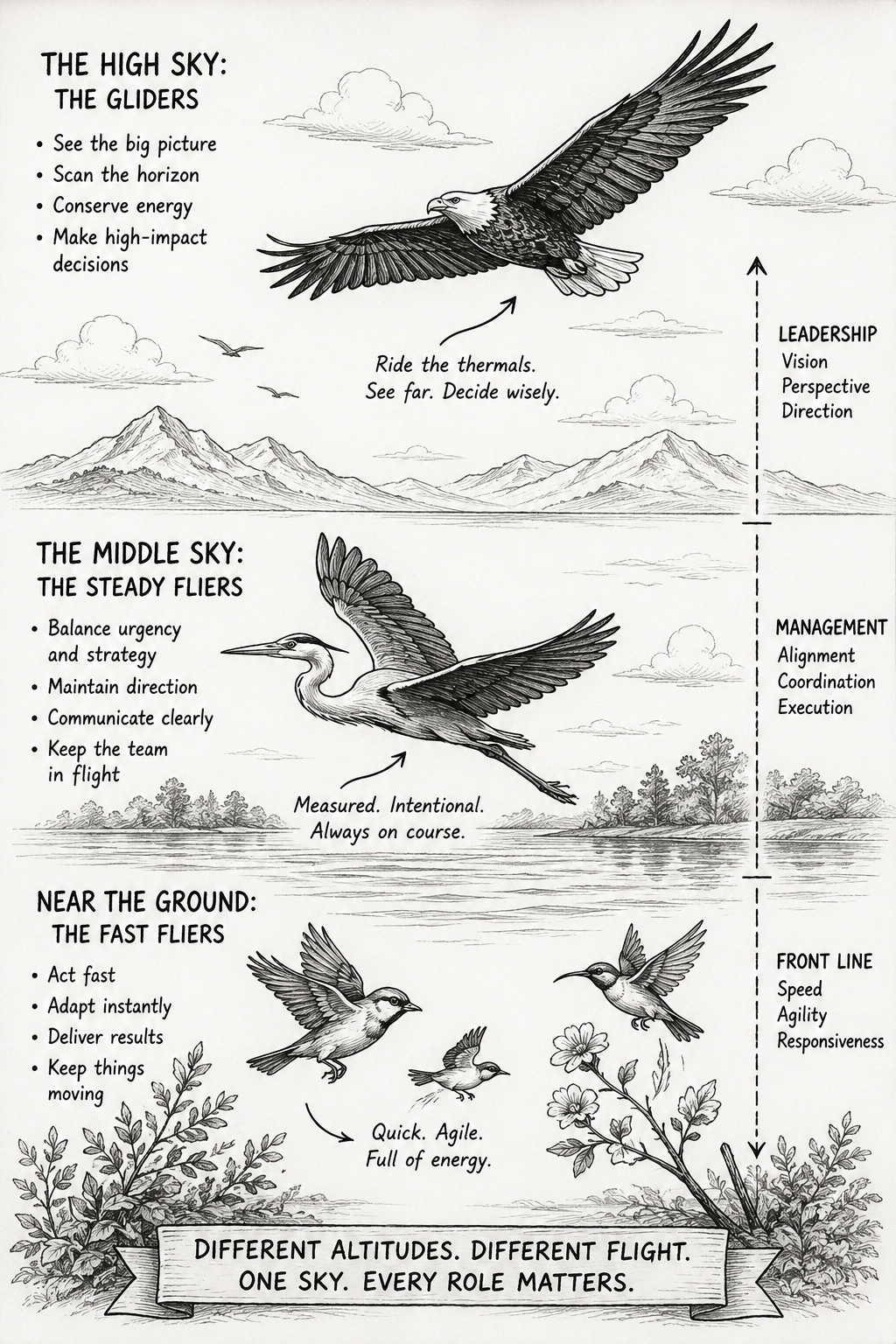
This morning, observing some herons fly by, I realized that not all birds fly the same way. The thought spiral resulting from that realization started evolving into an elegant lesson about how organizations work and why moving up the ladder demands more than just ambition. It demands transformation.
Near the Ground: The Fast Fliers
Near the ground, the air is alive with energy. Babblers dart between branches. Sparrows zigzag across hedgerows. Sunbirds hover and pivot with breathtaking speed. These birds are built for agility and quick reflexes, rapid decisions, constant motion. They do not glide; they hustle.
This is the world of the front-line professional. The executive who closes ten calls before noon. The analyst who turns around reports in hours. The field agent who thrives on pace, responsiveness, and the thrill of immediate results. At this level, speed is the skill. The ability to act fast, adapt instantly, and stay in constant motion is not just valued, it is considered as the job. The energy here is real, infectious, and absolutely necessary. Without it, nothing moves.
The Middle Sky: The Steady Fliers
Rise higher and the character of flight changes entirely. Watch a heron crossing a lake, and you will see something almost meditative: wings spread wide, measured wingbeats, a steady altitude, an unhurried but unwavering path. Watch a swan in flight and you will notice the same: every stroke deliberate, every movement purposeful, the direction never in doubt.
This is the domain of mid-level leadership. Managers who must balance the urgency below with the strategy above. The skill here is no longer pure speed; it is precision. Knowing when to act and when to hold. Communicating direction clearly. Maintaining momentum without burning out the team. Those who try to operate at this height with the frantic energy of a sparrow exhaust themselves and confuse those around them. The heron does not babble. It moves with intent.
The High Sky: The Gliders
And then there are the eagles. They barely seem to flap their wings at all. They ride thermals, invisible columns of rising warm air and use the energy of the environment itself to stay aloft. But do not mistake stillness for inactivity. The eagle’s eyes miss nothing. Its vision is sharp, wide, and long-range, scanning terrain that the sparrow cannot even conceive of.
This is the realm of leadership. The best executives do not micromanage the frenzy below. They read the landscape. They sense where the wind is going before others feel it shift. They conserve their energy for decisions that truly require it.
Altitude Demands Adaptation
The sparrow would struggle to soar at an eagle’s height. The eagle would look ridiculous darting between shrubs. Neither is lesser; they are simply calibrated for their altitude. The whole sky works because each bird has mastered its layer.
The most common failure in organizational growth is carrying the wrong flight style to a new height. Moving up is not just a change in title. It is a change in how you fly.
The question worth asking at every new level is simple: Am I still flapping when I should be gliding?
(Before you point out that eagles eat sparrows – yes, they do. But that is a different article about a different kind of organization. In the one we are talking about today, everyone has a role, and every role has its own genius.)

Enjoyed the parallelism Santosh! 👌🏽👌🏽👌🏽Best wishes.
Great content! Keep up the good work!