The modern world is not suffering from a lack of sight, but from an excess of images.
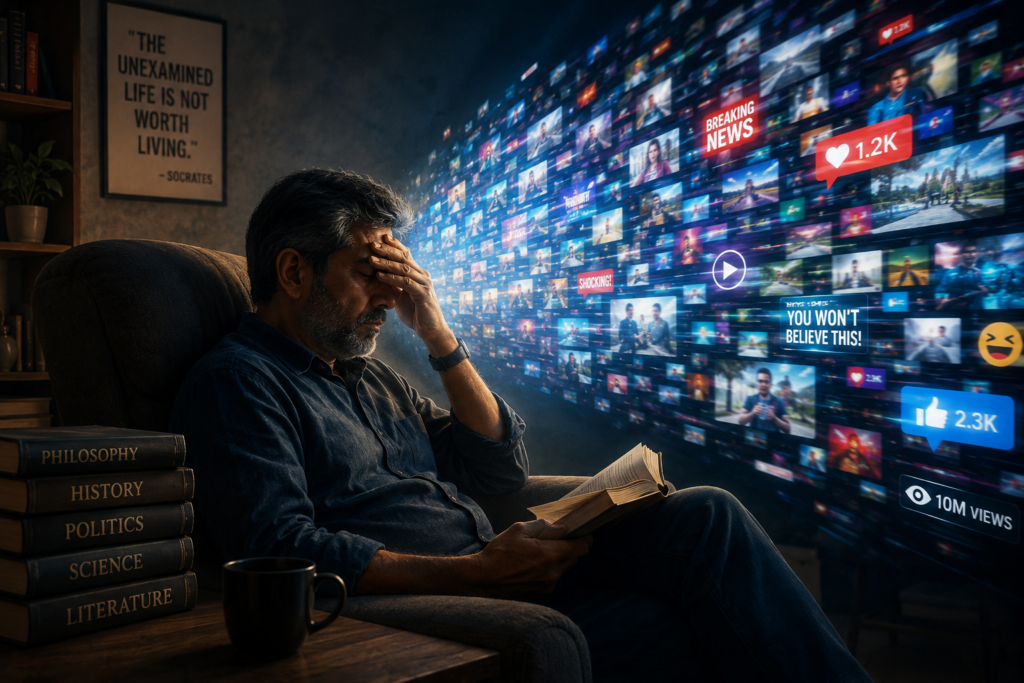
For most of my life, I believed the written word was one of the biggest boons to mankind. Books taught me to think. Essays taught me to question. Long conversations taught me the value of uncertainty. A book does not shout. It asks for your time, your attention, your willingness to sit with ideas that might challenge your own and there is something humbling in that exchange.
And yet, increasingly, I catch myself doing the one thing I never intended to do.
I scroll.
I watch videos in thirty-second bursts. I consume reels I know will add nothing to my life. I spend more time looking than reading, more time reacting than reflecting. I am also producing reels. Every night I promise myself that tomorrow I’ll pick up the book on my study table. More often than I’d like to admit, I don’t.
The troubling part isn’t that this happens. The troubling part is that I see it happening, and it happens anyway. So I started to wonder: if someone who consciously wants to read more keeps sliding back to visuals, what chance does anyone else have?
Maybe this isn’t a failure of discipline. Maybe it’s more about becoming a prisoner of the times we live in.
Human beings are visual creatures. For most of our history, survival depended on how quickly we could spot movement, recognize a face, react to danger. Visuals are immediate. They ask almost nothing of us. Reading, by contrast, is labor and it demands concentration, imagination, patience.
Algorithms understand this better than we understand ourselves. Every pause, every swipe, every click teaches the machine something about us. The machine learns what holds our attention and quietly gives us more of it. What starts as preference becomes habit. Habit becomes dependence. And dependence starts to look a lot like addiction.
Every time I choose a reel over a chapter, I purposefully try to remind myself that the algorithm is using me. This isn’t only a personal struggle. It’s a societal one, and I’ve watched it unfold in my own home.
My father now consumes more visual content than anyone else in our family. And I’ve noticed something else alongside it: his opinions have grown less balanced and more certain. Nuance has given way to conviction.
It took me a while to name what unsettled me about this. An algorithm that learns what you like will not challenge you. It will comfort you. It will reassure you that you’re right, and it will serve you the same idea in a hundred different wrappers until familiarity starts to feel like truth.
The result is a world of millions of people living in parallel realities. One person sees a nation in decline; another sees a nation on the rise. One sees the current generation is much advanced, while the other sees them wasted. Each believes they’re well informed, because each has watched hundreds of videos confirming what they already believed going in.
But seeing is not understanding. The role of visual media isn’t anymore about entertaining but narrowing our thoughts and, hence, our opinions.
Reading gives us the option to explore diversity of thoughts. Conversations push us to listen. Long-form writing rewards complexity. Visual algorithms reward engagement and nothing engages people quite like outrage, fear, and affirmation. Polarization is no longer an unintended side effect of technology. It is increasingly one of its products.
That may be why societies everywhere seem to be drifting toward extremes. The middle ground where dialogue, compromise, and humility live is quietly eroding. We are becoming more certain, and certainty is a dangerous thing to build a civilization on.
Socrates staked an entire philosophy on a single admission: I know that I know nothing. Today we carry devices in our pockets that whisper the opposite, on a loop: You are right. They are wrong. Watch this.
Censorship used to be visible. Books were banned. Newspapers were shut down. People knew when ideas were being suppressed, because the suppression left a mark. Today’s censorship is quieter. It doesn’t remove ideas, it distracts us from them. The most effective way to keep people from engaging with difficult ideas isn’t to ban the books. It’s to make everything else too entertaining to look away from.
A society that cannot hold its attention has a risk to hold its democracy, its institutions, or its collective wisdom. Perhaps the defining struggle of our age isn’t between truth and false. It’s between attention and distraction and the fact that it is designed.
I know, if I do not break my shackles, I am losing it. The modern world is not suffering from a lack of sight, but from an excess of images. And somewhere along the way, we blind ourselves with visuals.
